




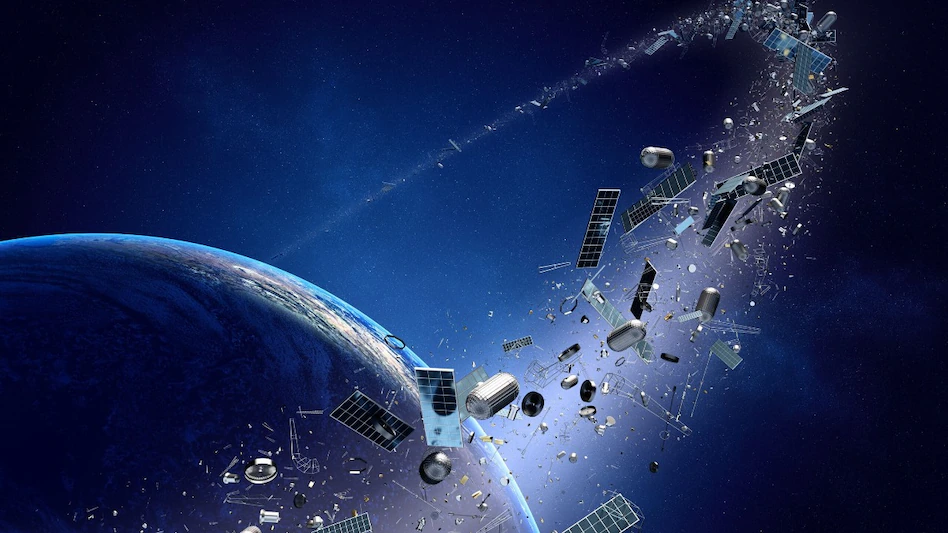
A new study by the Indian Space Research Organisation (ISRO) suggests that increased solar activity may play an unexpected role in reducing space debris in low Earth orbit (LEO). Scientists from the Space Physics Laboratory at the Vikram Sarabhai Space Centre (VSSC) have found that the Sun’s 11-year solar cycle significantly influences the rate at which defunct satellites and debris lose altitude and eventually move closer to Earth.
Published in Frontiers in Astronomy and Space Sciences, the research shows that when solar activity reaches around 67% of its peak, atmospheric drag increases due to the expansion of Earth’s upper atmosphere. This causes space debris to slow down and descend more rapidly, effectively contributing to the natural cleanup of congested orbital regions. Lead researcher Aisha M. Ashraf explained that higher solar activity intensifies ultraviolet radiation and charged particle emissions, heating the thermosphere and increasing atmospheric density at orbital altitudes. This enhanced drag forces inactive satellites and debris to lose altitude faster than under normal conditions.
The study tracked 17 defunct objects from the 1960s over a 36-year period, spanning multiple solar cycles. Researchers observed a clear threshold beyond which debris decay accelerates significantly, highlighting a direct link between solar behavior and orbital sustainability. This finding comes at a critical time as LEO becomes increasingly crowded with satellites, rocket remnants, and mega-constellations such as SpaceX’s Starlink. Scientists warn that collisions in orbit could trigger cascading debris events, threatening active satellites and future missions. The study not only provides new insights into space environment dynamics but also suggests that solar activity could be factored into future satellite mission planning and debris mitigation strategies.