





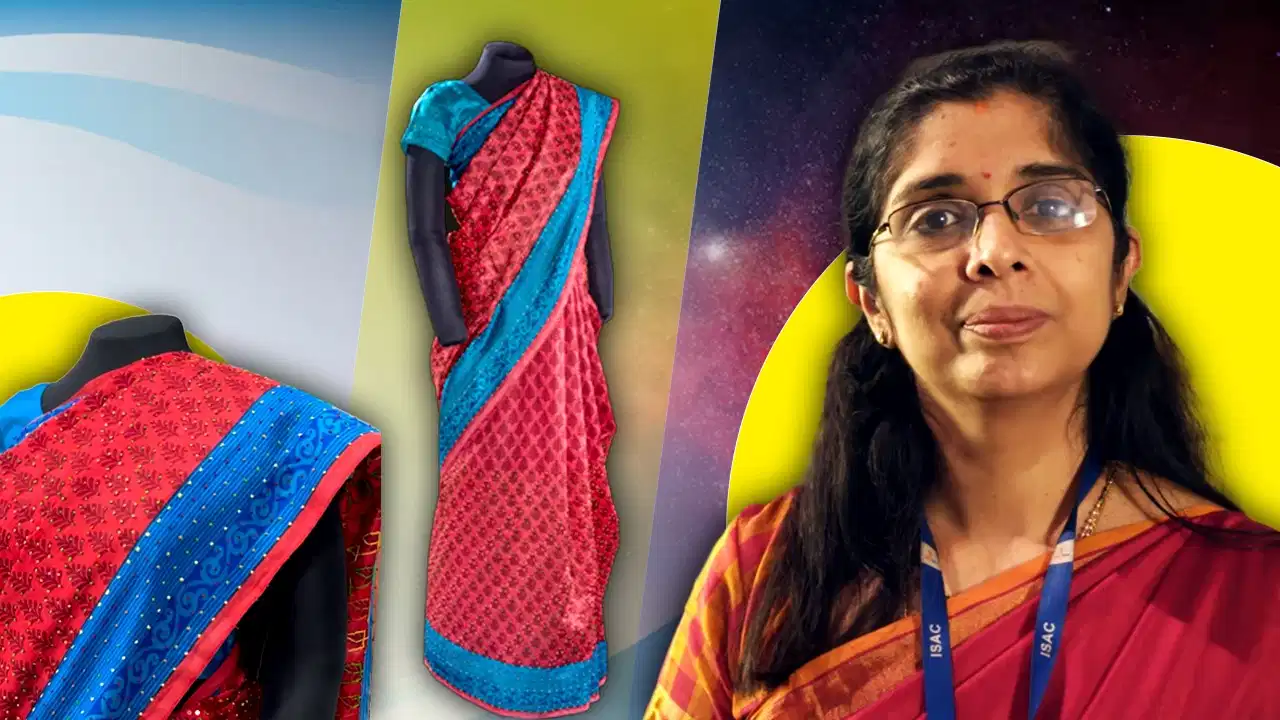
A saree worn by Indian space scientist Nandini Harinath during India’s historic Mars Orbiter Mission has found a place at the prestigious Smithsonian National Air and Space Museum in Washington, D.C. The display marks a significant global recognition of India’s scientific achievements and the contribution of women in space exploration. Known as India’s “Rocket Woman,” Nandini Harinath played a key role in Indian Space Research Organisation’s Mars Orbiter Mission, also known as Mangalyaan, serving as the Deputy Operations Director. The saree she wore during the spacecraft’s launch toward Mars has now become a symbol of India’s journey into interplanetary exploration.
The Smithsonian Museum shared images and videos of the saree on social media, describing it as more than just a garment. According to the museum, the saree represents India’s scientific progress and the growing role of women in space science. The display features a mannequin dressed in the bright red-and-blue patterned saree paired with a blue blouse. Although the saree itself never left Earth, the woman who wore it helped India become the first Asian nation to reach Mars orbit and the fourth country in the world to achieve the feat. ISRO launched the Mars Orbiter Mission on November 5, 2013, from the Satish Dhawan Space Centre. The mission aimed to study the Martian atmosphere and test interplanetary technologies. Originally planned for a shorter duration, the spacecraft continued operating around Mars for nearly eight years.
Nandini Harinath’s journey into space science began with a fascination for science-fiction shows like Star Trek and films such as Apollo 13. In a 2025 interview, she recalled how stories of exploration and teamwork inspired her to pursue a career in science and engineering. Born into a family of educators and engineers, Harinath went on to study engineering before joining ISRO. Over a career spanning more than two decades, she has contributed to over 14 space missions. Reflecting on the Mars mission, she once said the entire world was watching Mangalyaan, making it one of the most memorable projects of her life. The inclusion of her saree in the Smithsonian Museum is now being viewed as a powerful tribute to India’s growing influence in global space research and the achievements of Indian women scientists on the world stage.