





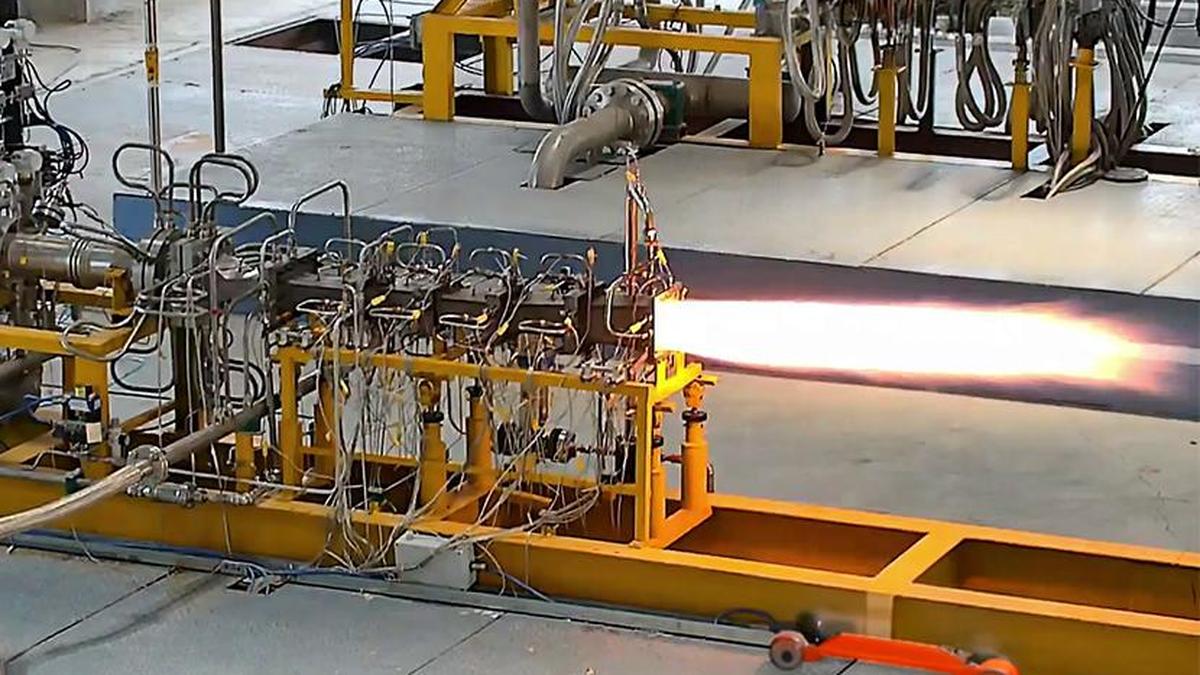
India has taken a significant step forward in advanced defence technology as the Defence Research and Development Organisation (DRDO) successfully tested an actively cooled full-scale scramjet combustor for over 1200 seconds. The test was conducted at the DRDL’s SCPT facility in Hyderabad, marking a crucial milestone in the country’s hypersonic cruise missile development programme. Defence Minister Rajnath Singh hailed the achievement as a historic advancement for India’s defence capabilities and praised DRDO scientists, industry partners, and academic institutions for their contribution to the breakthrough.
According to DRDO, the scramjet combustor operated continuously for approximately 20 minutes, nearly doubling the duration of its previous successful test of 700 seconds conducted in January. This extended performance is being seen as a major technological leap in India’s hypersonic research. A scramjet, or supersonic combustion ramjet, is an advanced propulsion system designed to operate at hypersonic speeds. Unlike conventional jet engines, it compresses incoming air at extremely high speeds and uses it for combustion, enabling efficient propulsion at altitudes and velocities where traditional engines fail.
Hypersonic missiles travel at speeds of Mach 5 or higher—five times the speed of sound or more. Such weapons are extremely difficult to intercept due to their high velocity and ability to evade radar-based defence systems, significantly reducing enemy reaction time. DRDO confirmed that the technology demonstrated in the test is fully indigenous. It includes the use of liquid hydrocarbon endothermic fuel, advanced thermal barrier coatings, and state-of-the-art manufacturing techniques. The project has also benefited from collaboration with Indian industry partners and academic institutions.
Experts believe that the successful development of hypersonic cruise missile technology would significantly enhance India’s strategic strike capabilities, enabling rapid and precise targeting of adversaries while bypassing advanced air defence systems. With this achievement, India joins a select group of nations—including the United States, Russia, and China—that are actively developing hypersonic weapon systems. DRDO Chairman Samir V. Kamat congratulated the entire team, calling it the result of sustained scientific and engineering excellence.