





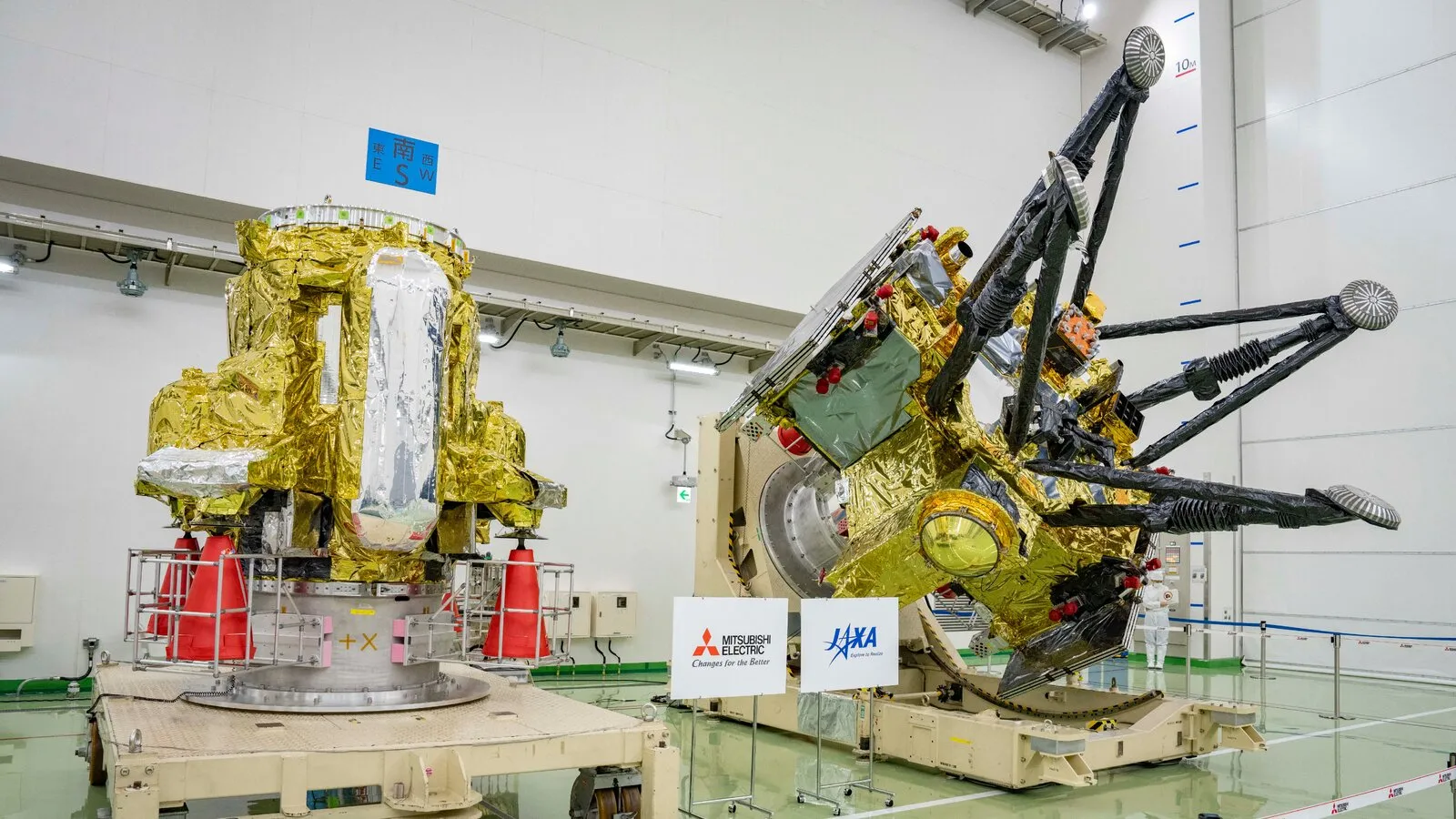
Japan’s space agency, the Japan Aerospace Exploration Agency (JAXA), is preparing for a groundbreaking mission to explore Phobos, one of Mars’ two natural moons, and bring samples of its surface back to Earth. The Martian Moons eXploration (MMX) mission aims to collect at least 10 grams of soil and rocky material to help scientists investigate the origin of Phobos and Deimos, understand the early history of Mars, and uncover clues about the formation of the solar system. The mission involves international collaboration, including contributions from France, Germany, the United States and other European partners.
The spacecraft was launched aboard Japan’s H3 rocket from the Tanegashima Space Center on October 20, 2026. It is expected to reach the Martian region in August 2027, where it will study both Phobos and Deimos. A French-German rover named IDEFIX will help survey Phobos’ surface and identify suitable locations for sample collection. The mission plans to gather material using specialised sampling equipment and return it to Earth in a heat-resistant capsule targeted for recovery in Australia in 2031.
Phobos and Deimos have long puzzled scientists, who are investigating whether they formed from debris following a major impact on Mars or are asteroids captured by the planet’s gravity. By analysing Phobos’ samples in laboratories on Earth, researchers hope to find evidence that could help resolve this mystery and improve understanding of Mars’ evolution and the early solar system. The MMX mission marks a major step in international planetary exploration and could also help develop technologies for future deep-space missions.