




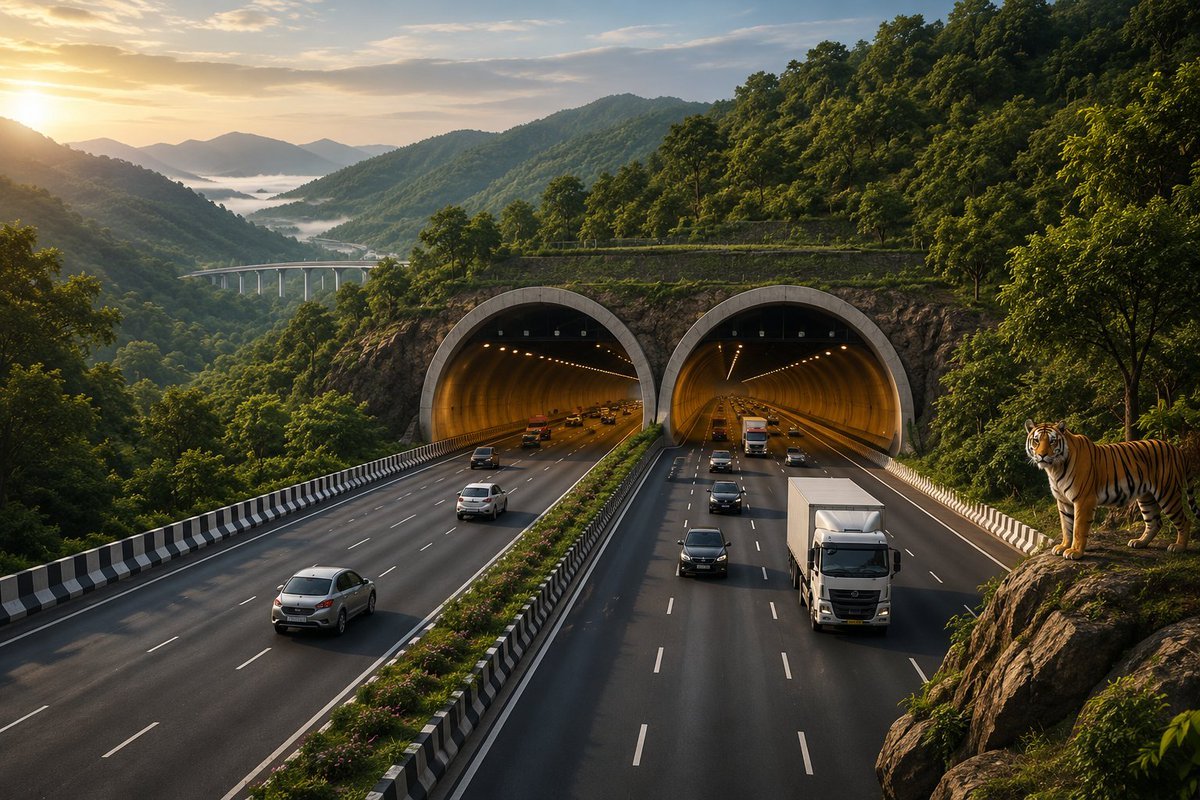
India’s ambitious Delhi–Mumbai Expressway is set to achieve another major milestone as the country’s first 8-lane tunnel in Rajasthan’s Mukundra Hills is expected to open to the public by the end of July. Stretching 4.89 kilometers in length, 22 meters in width, and 11 meters in height, the tunnel is part of a challenging 8.3-kilometer section constructed through multiple geological formations. Once operational, the entire expressway stretch connecting Delhi, Rajasthan, and Madhya Pradesh will become fully accessible, significantly improving travel across the region.
Designed with both infrastructure and environmental sustainability in mind, the tunnel features specially built ‘Cut & Cover’ sections that allow tigers and other wildlife to move safely across the habitat without human interference. Alongside the tunnel, the 26-kilometer Sawai Madhopur–Laban section is also expected to open by the end of July, further enhancing connectivity.
According to the National Highways Authority of India (NHAI), the 148-kilometer stretch between the Madhya Pradesh–Gujarat border and Vadodara is targeted for completion by October 2026. Once finished, 912 kilometers of the 1,386-kilometer Delhi–Mumbai Expressway—from Delhi to Vadodara—will be fully operational. Built at a cost of over ₹1 lakh crore, the Delhi–Mumbai Expressway is India’s longest expressway. Upon full completion, it is expected to reduce travel time between Delhi and Mumbai from nearly 24 hours to just 12 hours, transforming road connectivity and boosting economic growth across multiple states.