





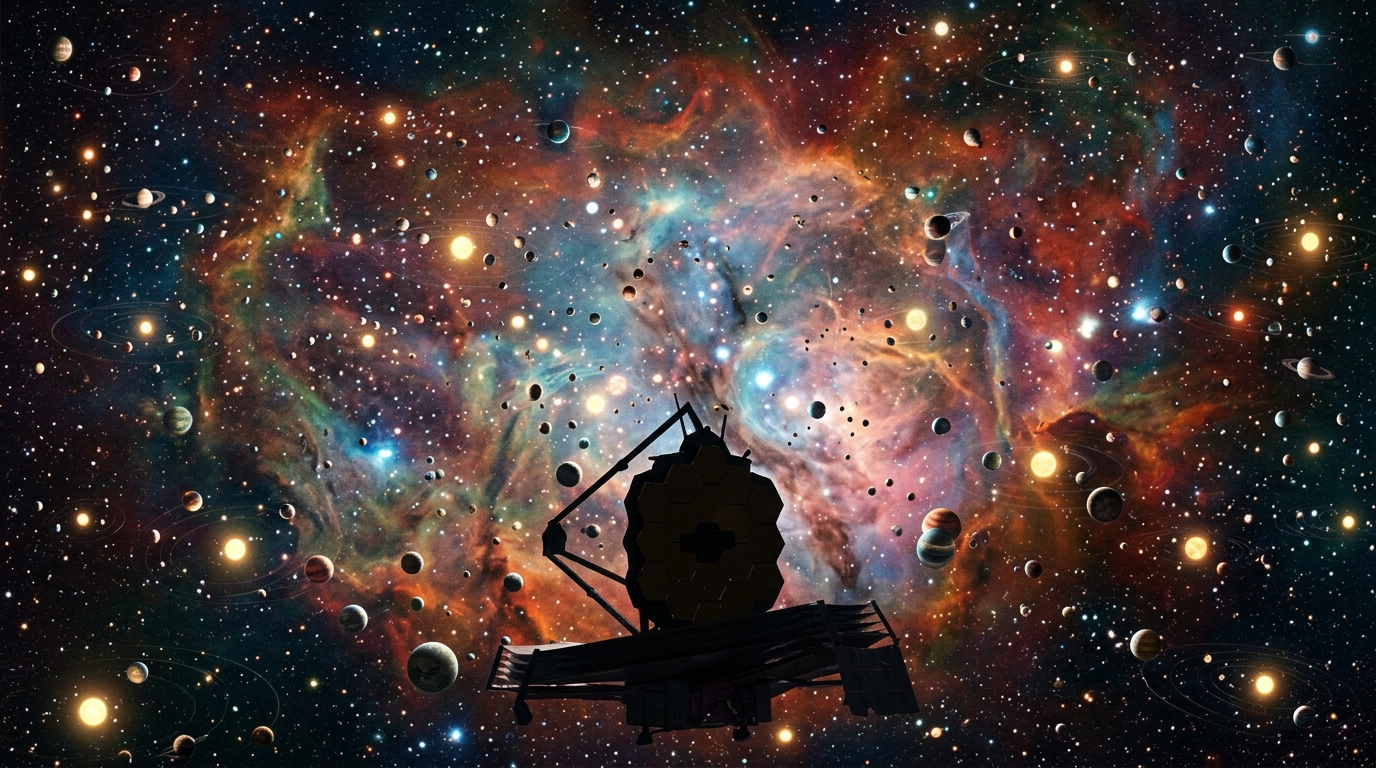
A major breakthrough by NASA has stirred the world of astronomy, as scientists have identified more than 100 new exoplanets using an advanced artificial intelligence tool called RAVEN. Among these, 31 planets are entirely new discoveries, marking a significant leap in space exploration. The findings are based on data from NASA’s Transiting Exoplanet Survey Satellite (TESS) mission, which has been systematically scanning the sky for planets beyond our solar system. Researchers from the University of Warwick analyzed this massive dataset.
RAVEN, the AI system behind the discovery, was trained on millions of simulated datasets. It is designed to distinguish between genuine planetary signals and other cosmic phenomena by analyzing subtle dips in a star’s brightness — a key method used to detect exoplanets. During the study, scientists examined data from over 2.2 million stars collected during TESS’s first four years. This analysis confirmed 118 new planets and identified more than 2,000 potential candidates, including around 1,000 newly flagged possible planets awaiting further verification.
Notably, the discovery includes several rare types of planets. Some orbit extremely close to their host stars, completing a full revolution in less than 16 days. Others belong to the category of ultra-short-period planets, circling their stars in under 24 hours. Researchers also found planets in the so-called “Neptunian Desert,” a region where such planets are rarely observed. Scientists believe this breakthrough not only accelerates the pace of exoplanet discovery but also provides deeper insights into how planets form and evolve across the universe.