





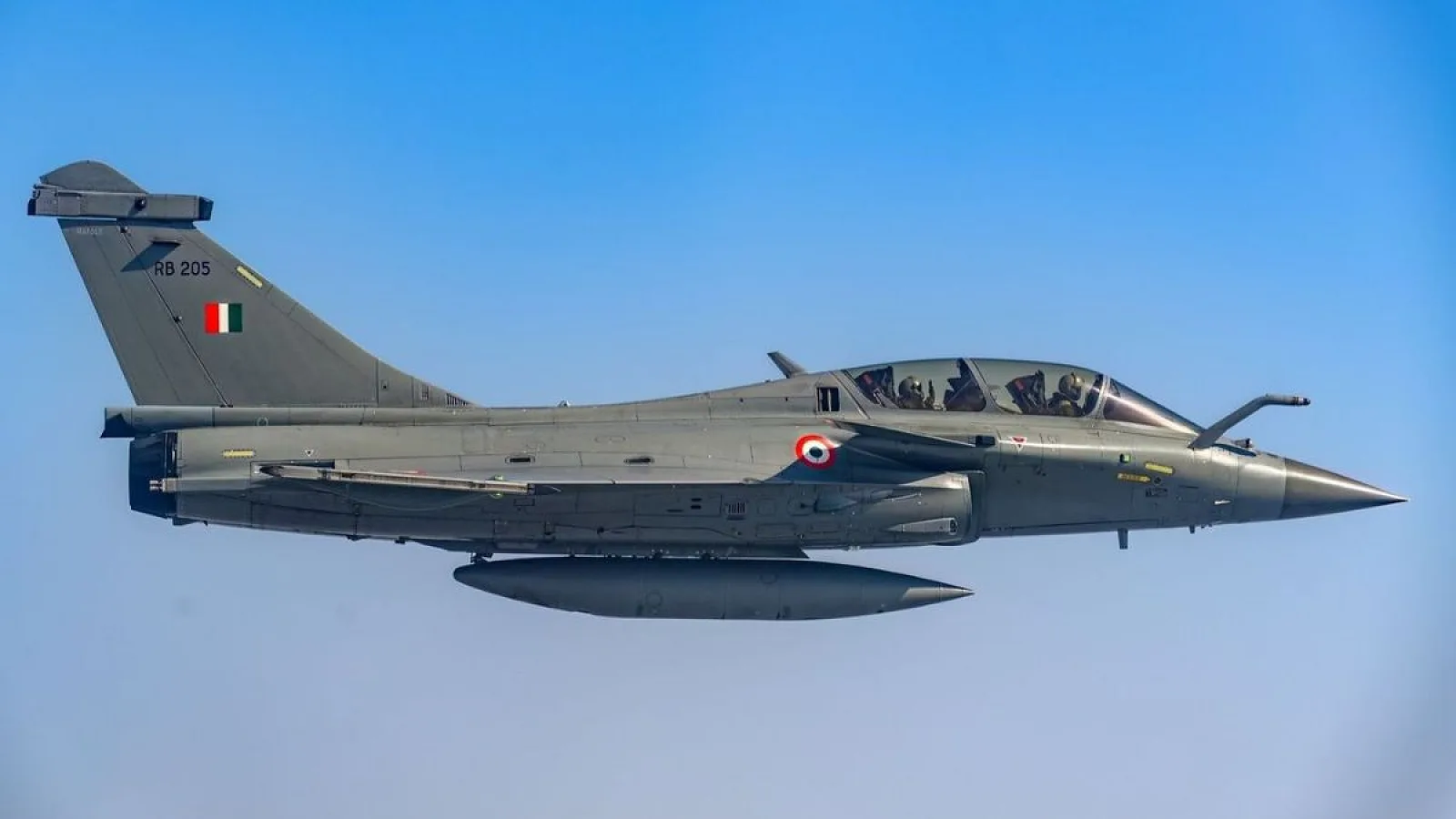
The Indian Navy has reportedly begun trials of the Rafale Marine (Rafale M) fighter jet at the Shore-Based Test Facility (SBTF) at INS Hansa in Goa. The trials are aimed at assessing the aircraft’s compatibility with India’s indigenous aircraft carrier, INS Vikrant, particularly its ability to take off from the carrier’s ski-jump ramp and land safely using arrestor wires. The testing marks an important step towards integrating the French-made naval fighter into India’s carrier-based aviation capabilities.
In April 2025, India and France signed an agreement for the acquisition of 26 Rafale M aircraft for the Indian Navy, comprising 22 single-seat fighters and four twin-seat trainer aircraft. The deal is valued at approximately ₹63,000–64,000 crore. Deliveries are expected to begin around late 2028 or early 2029, according to the reported timeline. The aircraft are primarily intended for deployment aboard INS Vikrant and are expected to replace the Navy’s ageing MiG-29K fleet. India also aims to explore their operational use aboard INS Vikramaditya.
The trials are particularly significant because INS Vikrant uses the Short Take-Off But Arrested Recovery (STOBAR) system. Under this configuration, aircraft take off using a ski-jump ramp and recover on the flight deck with the help of arrestor wires. The Rafale M, however, was originally developed for carrier operations involving the Catapult Assisted Take-Off But Arrested Recovery (CATOBAR) system. Consequently, extensive compatibility assessments are required to establish whether the aircraft can operate safely and effectively from India’s ski-jump-equipped carrier.
Developed by French aerospace manufacturer Dassault Aviation for the French Navy, the Rafale M is a twin-engine, multirole carrier-based fighter designed for air defence, air superiority, deep-strike missions, reconnaissance and anti-ship operations. The aircraft has a maximum take-off weight of approximately 24.5 tonnes and is powered by two Safran M88 turbofan engines. It can reach speeds of up to Mach 1.8, or approximately 2,200 km/h, under suitable conditions.
The fighter is equipped with carrier-specific features, including a reinforced landing configuration and an arrestor hook for recovery aboard aircraft carriers. Its avionics include the RBE2 active electronically scanned array (AESA) radar, designed to detect and track multiple aerial targets as well as maritime threats.
Successful completion of the trials would be a crucial step towards determining the Rafale M’s suitability for operations from INS Vikrant. The programme is expected to strengthen the Indian Navy’s carrier-based combat capabilities and enhance its ability to conduct air-defence and maritime strike missions across the Indian Ocean region. However, the aircraft’s operational integration will depend on the trial results and the completion of the required technical and operational evaluations.